01 / Context
Overview
This project compares several neural-network architectures for day-ahead Global Horizontal Irradiance (GHI) forecasting. The dataset contains five years of NREL solar and meteorological observations sampled at five-minute resolution, including irradiance components, temperature, humidity, cloud type, solar zenith angle, wind variables, and related features.
The time-series pipeline converts timestamped observations into sequential training samples and uses a 14-day historical window to predict the following day. MLP, RNN, LSTM, hybrid LSTM-RNN, and bidirectional LSTM models were trained and compared using MSE, MAE, and RMSE.
Project work
- Prepared a time-series forecasting workflow using the reported solar and meteorological data.
- Compared five neural-network architectures using a common day-ahead prediction task.
- Evaluated predicted-versus-target traces and the reported error metrics.
02 / Approach
Methods & diagrams
Dataset & Preprocessing
Five years of NREL data at five-minute resolution were cleaned, normalized, feature-selected, and converted into time-series windows.
Forecasting Models
MLP, RNN, LSTM, LSTM-RNN, and BiLSTM architectures were trained on the same prediction task.
Model Comparison
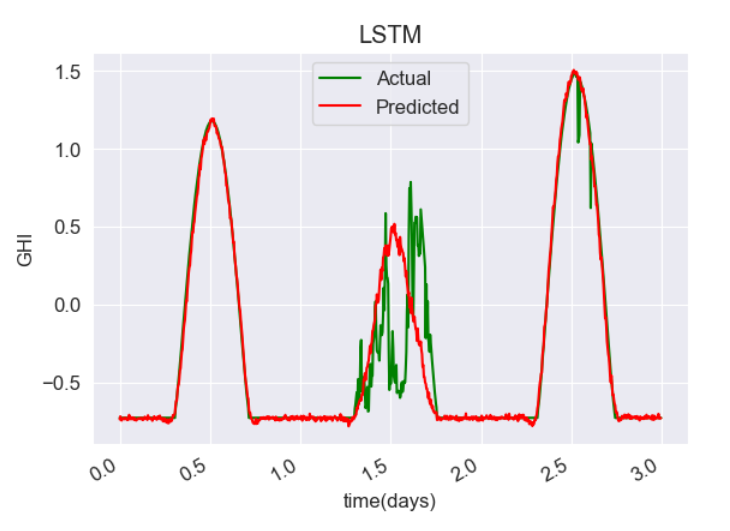
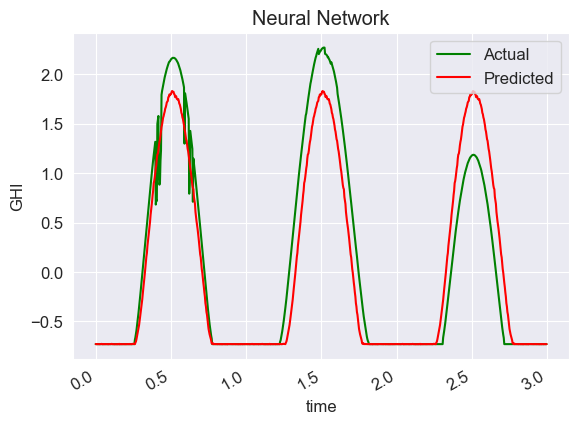
Testing performance was compared using MSE, MAE, and RMSE together with predicted-versus-measured GHI traces.
03 / Evidence
Results & gallery
Project figures and laboratory photographs. Open a figure to inspect the detail; vector PDFs are available for the control diagrams.
Findings
- The report compares MLP, RNN, LSTM, LSTM-RNN, and BiLSTM using predicted-versus-target traces and error tables.
- The five-minute input resolution limits the representation of more rapid irradiance changes.
Scope & limitations
This collaborative academic study compares models under a common dataset and preprocessing procedure. Results depend on the data split, input features, and five-minute sampling interval. Team and evaluation details are documented in the original report.